

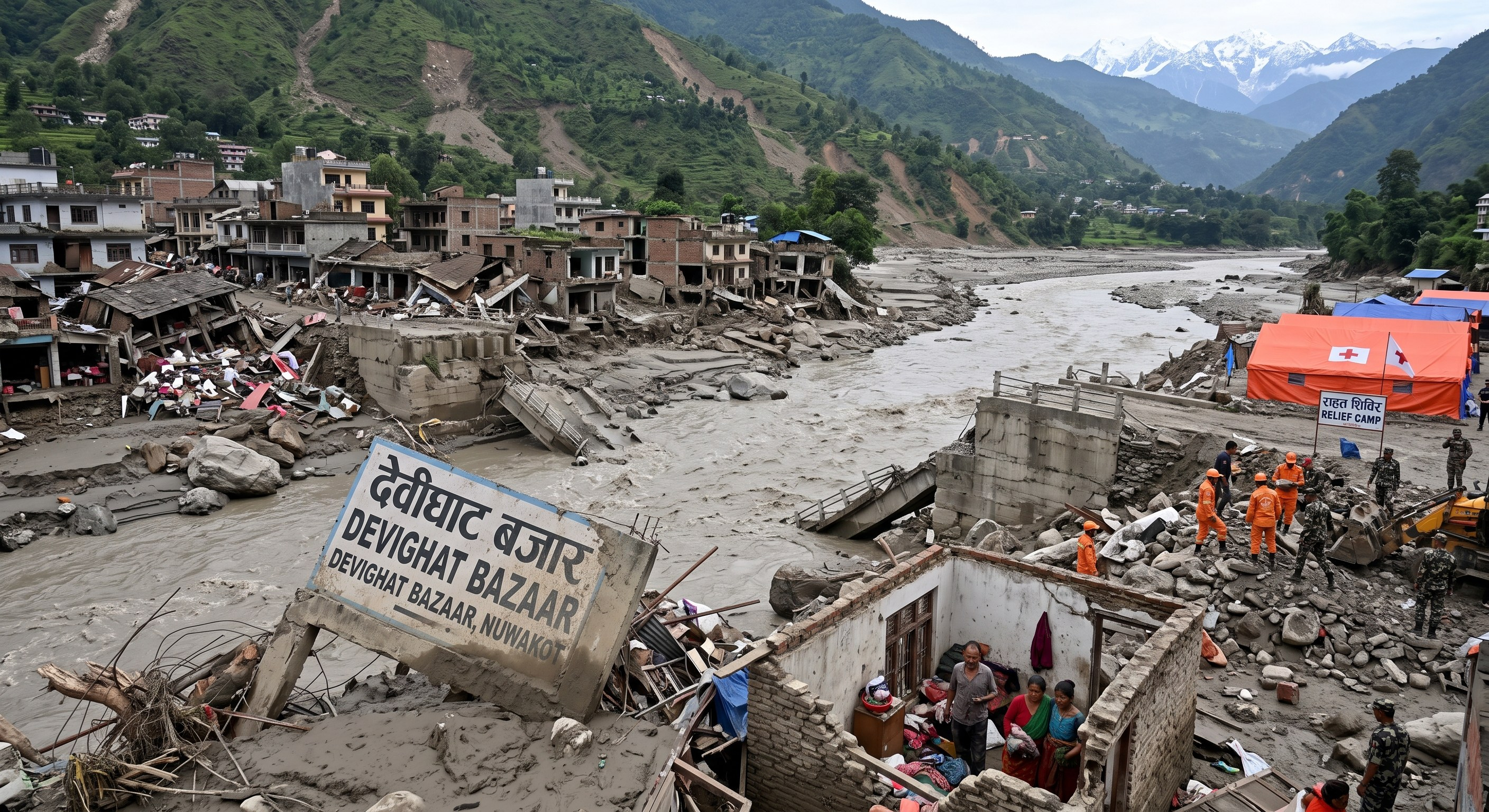
Climate change likely helped destabilize the glacier involved in the deadly Nepal-Tibet glacier flood that killed more than 1,300 people and left over 5,000 missing, according to the first scientific study examining the disaster.
Researchers found unusually warm conditions in the area before a large section of glacier and rock collapsed from Langtang Lirung on August 26. The event released an estimated 110 million cubic metres of snow and ice into the valley and triggered severe flash flooding downstream.
The scientists did not identify global warming as the disaster’s sole or direct cause. Instead, they concluded that rising temperatures had affected several conditions capable of weakening the glacier and surrounding mountain slopes.
Massive collapse triggered destructive flood
The section of overhanging glacier and rock involved in the collapse covered approximately 200,000 square metres.
It fell about 1,400 metres before striking the valley floor with enough force to register as an earthquake. The impact turned part of the ice into water and produced a fast-moving flow of water, snow, rock and sediment.
According to the report, the flood travelled at speeds exceeding 110mph, or about 177km/h. Communities downstream received little or no warning before it destroyed homes, settlements, roads, bridges and other infrastructure.
The study described rock avalanches of this scale as extremely rare. Events of a comparable size are estimated to occur approximately once every 1,000 to 10,000 years.
Record warmth preceded the disaster
The study was carried out by World Weather Attribution, a collaboration involving Imperial College London and climate specialists from other institutions.
Researchers found that the region surrounding the collapse has warmed by approximately 2 degrees Celsius since pre-industrial times. The estimated warming during July and August was about 1.5 degrees Celsius.
July and August 2026 were the warmest such months recorded locally. In the days leading up to the collapse, temperatures reached as much as 5 degrees Celsius above the 30-year average.
The study also found that the altitude at which temperatures fall below freezing in the Himalayas has risen by approximately 100 metres per decade since the 1980s. Longer and more frequent periods of thawing can weaken slopes held together by permafrost.
Glacier retreat removed stabilizing ice
Decades of warming have caused substantial glacier retreat around the collapse site, the researchers reported. The loss of ice may have reduced support for the surrounding terrain, while glacier melting also contributed additional water to the area.
Dr Ben Clarke of Imperial College London said the long-term changes surrounding the glacier showed the influence of climate change on the high-mountain environment and several potential drivers of the collapse.
Researchers also considered the possible effect of Nepal’s magnitude-7.8 earthquake in 2015. The earthquake may have contributed to slope instability, but the study could not determine its precise role in the August 2026 disaster.
Study stops short of identifying a single cause
World Weather Attribution researchers said the disaster resulted from several interacting geological and environmental factors. Their analysis did not establish climate change as the single fundamental cause of the collapse.
Instead, the study identified global warming as a destabilizing influence that altered temperatures, glaciers, permafrost and mountain slopes over an extended period.
Dr Friederike Otto, a climate science professor at Imperial College London, said communities in Nepal were suffering the consequences of a climate crisis largely driven by fossil-fuel emissions produced elsewhere.
Madhab Uprety, a senior technical adviser at the Red Cross Red Crescent Climate Centre, said the human and financial costs demonstrated the need for fairness in supporting climate-vulnerable countries that have contributed little to global emissions.
Nepal seeks international financial support
Nepal has submitted a formal request for assistance from the United Nations loss and damage fund to help address the destruction caused by the flood. Accessing that support requires evidence connecting the disaster to climate change.
Nepal’s foreign minister, Shisir Khanal, has also called on major emitting countries, including China and India, to recognize a shared responsibility for addressing the disaster’s consequences.
The study’s findings provide evidence that climate-driven warming affected conditions around the glacier, although researchers emphasized that the catastrophe cannot be attributed to one factor alone.



Join the conversation
Comments are reviewed before publication. Your email stays private.